Special Types General Order - STGO
There are certain types of loads that most people would refer to as Abnormal Loads but which fall within the bounds of the Construction & Use Regulations (C&U). However, in the main, those vehicles that carry Abnormal Indivisible Loads (AIL) are recognisable by the placard on the front of their vehicles.
This placard (see below) indicate the carrying capabilities of the vehicle and subsequently assist greatly in the identification process. Where those vehicles that fall under the Special Types General Order (STGO) 2003
- Special Types General Order (STGO) Category 1
- Special Types General Order (STGO) Category 2
- Special Types General Order (STGO) Category 3
the use of these categories is allowed under the regulations to carry more than one abnormal load. However, there are constraints attached.
Please find further information below, you can download a copy of the 'Aide Memoire' if you are not complying with Construction & Use (C&U) regulations.
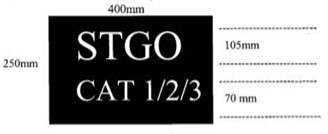
STGO Placards
Abnormal load-carrying vehicles must display a sign at the front to aid identification and state the relevant category. The sign below shows white lettering on a black background and measures 400 mm x 250 mm. The word STGO should be in letters 105 mm in height, with the Category shown below in letters 70 mm in height. All text should be fully centralised on the placard.
Speed Limits
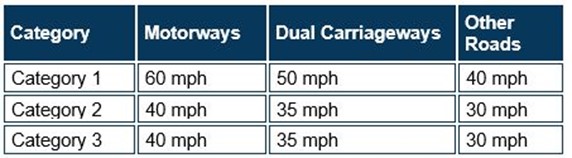
There are speed limitations to STGO vehicles as indicated in the table below.
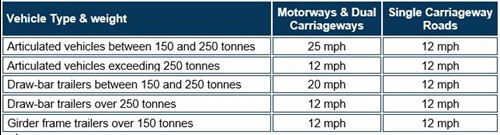
On 29 November 2010, the speed limit for articulated vehicles weighing between 150 and 250 tonnes increased to 25 mph. For draw-bar trailer vehicles weighing between 150 and 250 tonnes, it increased to 20 mph. Girder frame trailers remain restricted to 12mph – see table below. The speed limits will be specified in the permit when issued.
More than one Abnormal Load
Only one abnormal load may be carried on a vehicle or combination at one time, except as follows:
Category 1
Two or more AIL may be carried if they are of the same character. An AIL together with articles of a 'character similar to the load' is also permissible.
In practice, this only applies to wide and/or long loads. To apply to heavy loads, one load would have to make the vehicle exceed 44 tonnes GVW, which would then place the vehicle under STGO regulations.
A second load 'of similar character' can also be carried under Cat 1. However, the second load must not make the vehicle exceed 50 tonnes GVW, in other words, it must remain within Category 1.
Category 1 and Category 2
Two or more AIL's may be carried if:
- Each load is the same character; and
- They are loaded at the same place and carried to the same destination; and
- The overall width of any vehicle used does not exceed the width necessary to carry the widest single load; and
- The overall length does not exceed the length necessary to carry the longest single load
An AIL consisting of engineering plant, together with constituent parts detached from the plant, may be carried if:
- The engineering plant and its detached parts are loaded at the same place and carried to the same destination; and
- The detached parts do not constitute any lateral, forward, or rearward projection of the load that exceeds any projection existing without those parts
Application of Construction & Use Regulations
The Special Types order allows special types of vehicles some concessions from the standard C&U regulations. Category 1 vehicles are only excluded from the standard dimensional regulations. They are subject to all other normal rules, such as on braking.
Category 2 and 3 vehicles are subject to braking standards that require conformity with the construction, fitting, and performance criteria of EU Directive 71/320 - although the order of the special types spells out the most stringent requirements that can be met. As a further concession, wheel chocks may be used with the parking brake to achieve the required efficiency.
There are no extra regulations on lighting, but vehicles carrying AIL are likely to have to meet the special lighting and other provisions which apply to long loads, supported loads, and projecting loads, including fitting trailer corner lamps or side marker lamps
'Aide Memoire'
An 'Aide Memoire' for action when not complying with C&U regulations is available for download below:
Contact Details
Forms and inquiries should be sent to:
Highways England
Abnormal Loads Team
9th Floor, The Cube
199 Wharfside Street
Birmingham, B1 1RN
Tel: 0300 470 3004
Email: abnormal.loads@highwaysengland.co.uk