Special Types (General Order 2003) STGO
The dimensions and weights of vehicles used on British roads are regulated by the Road Vehicles (Construction & Use) Regulations 1986 (C&U) and the Road Vehicles (Authorised Weight) Regulations 1998 (AW)
There are some 'Special Types' of vehicles that don’t meet the C&U and AW Regs but can be used outside these rules under the authority of the Road Vehicles (Authorisation of Special Types) (General) Order 2003 (STGO).
Vehicles that do not comply with an STGO order can be used on the road if Special Orders have been issued by:
- Highways England regarding abnormal loads that are not covered by C&U and STGO
- The Vehicle Certification Agency (VCA) regarding special vehicles and divisible loads such as crane ballast which are outside the scope of C&U and STGO
Vehicles most likely to be used under an STGO
Vehicles most likely to be used under an STGO are:
- Abnormal indivisible load (AIL): loads that can’t be divided into 2 or more loads to be transported by road
- Mobile cranes: specially built or adapted for lifting operations
- Engineering plant: a moveable piece of plant or equipment which is a motor vehicle or trailer specially built for engineering operations
- Road recovery vehicles: vehicles that are specially built for recovering broken-down vehicles
Under Construction & Use
When trailers are built and normally used to carry indivisible loads of great length (that is; abnormal indivisible loads) - they can be longer, but not wider than the normal legal maximum.
There is no limit to the number of items of exceptional length that can be carried. Depending on the size of the load and if certain conditions are met, C&U Regulations also allow loads to overhang the front, rear, and sides of vehicles.
These conditions include:
- Making the load easily visible
- Informing the police and highways authorities
A brief guide to C&U rules for overhanging loads to the front, rear, or side can be found on the.Gov website at Annex A
Abnormal Indivisible Load vehicles
AIL vehicles can be used if a load cannot be divided for transportation by road. A good example is an aircraft wing which when given the cost involved it would be unreasonable to have to disassemble it first. On the other hand, a large load that can be easily divided in half by undoing a few bolts must be split up for transport.
Loads that comply with C&U and AW Regulations cannot be carried on an AIL vehicle, even as a back-load. When an AIL vehicle is dual-plated, for both C&U and STGO use, then normal loads can be carried in line with the weights set out on the ministry plate for the vehicle or trailer.
If possible and safe, a ‘normal-sized’ vehicle or vehicles must be used to carry a load, even if there’s some overhang at the front, rear, one or both sides of the vehicle. Where it is not safe to use a ‘normal-sized’ vehicle, then a larger vehicle or combination of vehicles will need to be used, subject to any conditions in STGO.
AIL vehicles are divided into 3 categories and must comply with these conditions to operate under STGO:
Cat 1 (not exceeding 46,000 kgs / 50,000 kgs):
- Up to 46,000 kgs with a minimum of 5 axles
- Up to 50,000 kgs with a minimum of 6 axles
- AW Regulations maximum weights apply to axle and vehicle gross weights meaning, only the train weight can exceed AW Regulations
- Display ‘STGO Cat 1’ plate to the front of the drawing vehicle
- 2 working days’ notice must be given to highway and bridge authorities in relation to weight, and the dimensions may need to be given to the police
- Speed limits:
- Motorway 60 mph
- Dual carriageway 50 mph
- Other roads 40 mph
Cat 2 (not exceeding 80,000 kgs):
- Minimum of 6 axles
- Maximum axle weight of 12,500 kgs
- Display ‘STGO Cat 2’ plate to the front of the drawing vehicle
- 2 working days’ notice must be given to highway and bridge authorities in relation to weight, and the dimensions may need to be given to the police
- Speed limits:
- Motorway 40 mph
- Dual carriageway 35 mph
- Other roads 30 mph
- A plate must be fitted to the vehicle showing the maximum weight recommended by the manufacturer of the vehicle when travelling at certain maximum speeds. This must be marked ‘Special Types Use’ and the plate should show the weights for gross, train, and axle weights
Cat 3 (Not exceeding 150,000 kgs):
- Minimum of 6 axles
- Maximum axle weight of 16,500 kgs
- Display ‘STGO Cat 3’ plate to the front of the drawing vehicle
- 5 working days’ notice to be given to highway and bridge authorities and the dimensions may need to be given to the police
- Speed limits:
- Motorway 40 mph
- Dual carriageway 35 mph
- Other roads 30 mph
- A plate must be fitted to the vehicle showing the maximum weight recommended by the manufacturer of the vehicle when travelling at certain maximum speeds. This must be marked ‘Special Types Use’ and the plate should show the weights for gross, train, and axle weights
There is no need to carry 'Movement Order Notices' in all categories of these types of vehicles.
Special Order Movements
You must have a special order for vehicles more than:
- 150,000 kgs or 16,500 kgs in weight per axle
- 1 meter wide
- 30 meters long in rigid length when loaded
You will need to give:
- 5 working days’ notice to highway and bridge authorities
- 2 working days’ notice to the police
You must carry the 'Special Order Authorisation' for the vehicle movement (issued on behalf of the Secretary of State by Highways England, Birmingham office) in the vehicle. Otherwise, it will be operating under C&U and AW Regulations.
Vehicle Signage
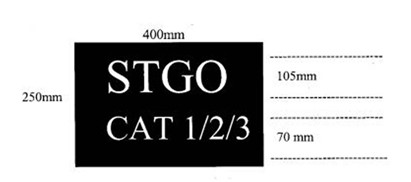
This sign should be fixed to the front of the vehicle in a Vertical Position.
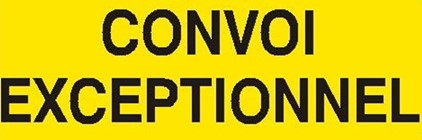
Non-GB AIL vehicles usually display the “Convoi Exceptionnel” sign shown below.
Multiple Loads
Generally, multiple loads cannot be carried, but they are allowed in 2 special cases:
- Engineering plant - Component parts can be carried in cases where:
- The plant, without the detachable part, is an STGO AIL (meaning, it cannot legally be carried on a C&U/AW vehicle)
- The part is loaded and unloaded at the same place
- The part does not stick out beyond the vehicle more than the plant itself protrudes, whether forward, rearward or to the side, e.g. a bulldozer with a detachable blade. A trailer towed by the bulldozer is not allowed to be carried on the same vehicle
- Where 2 or more loads of a similar shape, size, and weight need to be moved and:
- One or both are STGO AIL (that is: cannot legally be carried on a C&U/AW vehicle) falling into STGO Category 1 or 2 only
- The second (identical or smaller) load does not increase the overall width or length of the combination or take it into a higher STGO category on weight
In addition to the above, long (but not heavy) loads can normally be carried on long trailers that still meet C&U. Multiple loads are allowed in this case as long as they are not bigger than AW weights e.g. a number of 16 m long yacht masts could be carried by a longer length trailer.
Vehicle Excise Duty
A vehicle carrying goods under STGO is taxable in the ‘Special Types’ taxation class. Find out how much you should be paying from the guidance in Rates of vehicle tax (V149)
V149 Rates Of Vehicle Tax From 1 April 2020 For Cars, Motorcycles, LGV And Private LGV (pdf, 0.2 MB)
Plating and Testing
Vehicles and trailers operating under STGO and Special Order do not have to be tested or plated if solely used for transport of AIL. Standard width vehicles and trailers used for AIL movements are normally ‘dual plated, which means that they are subject to a yearly test and plating because they can be used for both AIL and ‘normal C&U’ loads.
Drivers’ Hours and Tachograph Regulations
Goods vehicles operating under STGO and Special Order have to follow EU drivers’ hour's rules and tachograph regulations.
Drivers view to the rear mirrors
AIL vehicles and vehicles operated under STGO have to follow the rules on mirrors under C&U Regulations. The rear-view mirrors must provide the driver with a clear view to the rear and side of the vehicle. Because the load being carried projects out, the view from standard mirrors will not normally be adequate. The view from standard mirrors should be good enough to see past the overhanging load. To allow a better view, the existing mirrors may need adjustment, additional mirrors or other devices may have to be fitted e.g. cameras/monitors.
A camera system can be used in place of the mirrors as long as the driver can clearly see to the side and rear of the load. It is not suitable if the driver cannot see fully down the side of the trailer past a wide load. Drivers must have a clear view regardless of whether there is an escort vehicle. But, where drivers do not have a clear view and vehicles are operated under STGO where an additional rear steer driver is present on the vehicle combination or where the vehicle is under police escort - this may be allowed
Non-GB Vehicles
Non-GB vehicles operating within this country are subject to the same rules about dimensions and weights contained within the C&U and AW Regulations. They are able to take advantage of the STGO exemptions to the above rules according to the same conditions. The use of alternative signage, typically the French ‘Convoi Exceptionnel’ and the square white/red ‘chevron’ plates are acceptable within GB.
Enforcement
The STGO Regulations and Special Orders provide certain exemptions to C&U and AW Regulations, therefore no offence exists for failing to comply with STGO and Special Order Regulations. A failure to comply with any of the rules relating to the particular STGO and Special Orders listed above would result in the exemptions not being applicable and the C&U and AW Regulations coming into force.
- Exceeding recommended speed limits - The offence of going faster than the stated speed limits ceases as soon as the vehicle is stopped and therefore no prohibition can be issued. Records of excess speed while operating under STGO may be brought to the attention of the traffic commissioner if required
- Failure to display STGO signage - The STGO exemption would then be breached and the load would be subject to normal C&U and AW limits in relation to dimensions and weight. Enforcement action may then be taken as required
- Failure to comply with movement order - If the vehicle does not comply with the notice provided to the relevant authorities in respect of the details below, the exemptions will not apply and the necessary enforcement action may be taken:
- Weight
- Dimensions
- Operator
- Route
There is no need for the Movement Order to be carried on board. If the movement is covered by a Special Order (such as weight in excess of 150,000 kg) then this must be carried on board.
Weight: if the axle, gross or train vehicle weight is more than those stated in the notice given to the relevant authorities, for the STGO category, the amount of the overload should be calculated against the AW Regulations. e.g. 44,000 kgs train weight for a 3x3 articulated vehicle.
Legislation
This guide should be used together with the legislation and regulations for Special Types vehicles (below):
- The Goods Vehicles (Plating & Testing) Regulations 1988
- Schedule 2(35) Exemption to plating and testing regarding vehicles defined within S42 (special vehicles) The Road Traffic Act 1972
- The Road Traffic Act 1972
- The Road Traffic Act 1988
- The Road Vehicles (Construction & Use) Regulations 1986
- The Road Vehicles (Authorisation of Special Types) (General) Order 2003
- schedule 1: abnormal indivisible loads
- schedule 2: mobile cranes
- schedule 3: engineering plant
- schedule 4: road recovery vehicles
- The Road Vehicles (Authorised Weight) Regulations 1988
- The Vehicle Excise and Registration Act 1994