ADR Driver Requirements
There are specific points which must be adhered to at all times by drivers carrying dangerous goods.
Part 8 of ADR covers most of the elements that the carrier has to deal with, and includes:
- Driver training
- Equipment to be carried, including fire extinguishers, wheel chocks, pocket lamp, warning signs, warning vest etc.
- Documentation
Transport Unit
Some duties refer to the "transport unit" and some to 'vehicles'. The transport unit may be one vehicle or may comprise a tractor unit and semi-trailer (articulated lorry) or a rigid lorry and trailer (drawbar combination). A vehicle most obviously is a lorry or van but it also includes a trailer. Accordingly, an articulated lorry or drawbar combination is two vehicles, but one transport unit. The vehicle is defined in Article 1 and in Part 9 of ADR
Equipment & Documentation
ADR Chapter 8.1 covers equipment and documentation. This is grouped into the following main parts:
- Documents (8.1.2)
- Placarding and marking (8.1.3)
- Firefighting equipment (8.1.4)
- Miscellaneous equipment (8.1.5)
Requirements are:
- Orange plates to be displayed front and rear of the vehicle, whilst loading, unloading and in transit.
- To read and understand the Transport Emergency Card (Tremcard) before taking responsibility for the load.
- An ADR Vocational Training Certificate to be with the driver at all times whilst carrying dangerous goods.
- The driver must have the correct transport documents required for the goods.
- Photographic identity is required for High Consequence Dangerous Goods.
- The Vehicle Certificate of Approval if required carrying, Fl, OX, EX or AT.
- Drivers should be knowledgeable in the use of a fire extinguisher.
- One or more wheel chocks suitable for the size of the vehicle should be present. If driving abroad these must be plastic or rubber.
- No smoking or naked flames.
- No opening of packages. (except UK Regulations)
- No passengers, unless a crew member with ADR with their own Personal Protective Equipment (PPE).
- There will be load specific requirements also to adhere to.
- Placards to be in place on the sides and rear of the vehicle when carrying Class 1 and Class 7 Goods.
Personal Protective Equipment (PPE)
Drivers have a requirement to have the correct PPE with them whilst carrying dangerous goods. The list is on the Tremcard and should include the following as detailed in the table below:
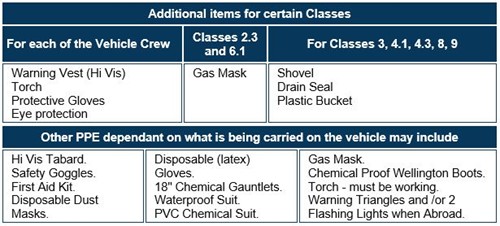
Also, any load specific safety equipment, such as antidote packs, shovels, brooms, and fire extinguishers other than dry powder extinguishers.
The following items carried in the PPE kit must be in date:
- Hard hat - no more than 5 years old, date to be found under the peak of the cap.
- Gas mask respirator filter - expiry date to be printed on the canister.
- Eyewash bottle - expiry date to be printed on the bottle.
The following list includes items that should be in any Spill Kit Hazard Cupboard.
- Fire Extinguishers - a 2 kg fire extinguisher for the vehicle cab.
- Vehicles up to 3.5 tonne - 2 x fire extinguishers of 4 kg minimum capacity.
- Vehicles 3.5 to 7.5 tonne – 2 x fire extinguishers minimum total capacity 8 kg dry powder, of which one to be at least 6 kg.
- Vehicles more than 7.5 tonne – 2 x fire extinguishers minimum capacity 12 kg, of which one to be minimum capacity 6 kg.
- For vehicles carrying goods under 1.1.3.6 - fire extinguisher of 2 kg for the vehicle cab.
The capacities are for dry powder devices or the equivalent capacity for any other suitable extinguishing agent.
It is important that with regard to fire extinguishers that:
- Seals are intact
- Labels showing the expiry date are legible, and the next service date is a future date
- The pressure gauge is in the 'green' area
The normal type of fire extinguisher for a vehicle is a dry powder extinguisher
|
Extinguisher colour coding |
|
|
Red Cream |
Water / Foam |
It is the responsibility of the driver to:
- Read the Tremcard to understand the nature of the hazard
- Read the Dangerous Goods Note to ensure he/she holds an ADR licence for the goods to be carried
- Wear safety equipment if provided or necessary as defined in the Tremcard
- Ensure the correct status of the dangerous goods from the consignor
- Ensure he/she has a copy of Tremcard
- Ensure the goods on the vehicle are correctly labelled and addressed
- Ensure he/she has the correct documents relating to the load, Dangerous Goods Note & Tremcard
- Mark the vehicle correctly with orange plates and placards if Class 1 & 7
- Ensure there is correct PPE, fire extinguishers and vehicle equipment for the load
- Ensure the vehicle is cleaned after any spillage
- Ensure there is no loading of incompatible goods
- Have knowledge of the emergency procedures
- Ensure the Container Packing Certificate is signed before he/she sets out to ship out
- Ensure the packages are loaded safely
- Keep the Tremcard readily available in the vehicle cab
- Plan the journey to include safe parking if required
- Report any suspicious behaviour around the vehicle
- Report any tampering of the load to the employer
- Report any accident regarding the load to the employer
- Know what to do in an emergency
- Know not to fight a fire on a load - see below
In the event of a fire on a Dangerous Goods Load
A driver should not fight a fire on a dangerous goods load but should:
- alert the emergency services
- be available when the emergency services arrive and provide the load information
- alert the local populace and keep them clear of the danger.
European ADR - Driving Restrictions
Please go to the Driving Abroad page within this Dangerous Goods Section.
Police and DVSA Checks
The police or Driver and Vehicle Standards Agency (DVSA) will target and stop Dangerous Goods loads for compliance. Once stopped, the authorities will examine the driver's papers and ask questions about the load e.g. UN No, product, fire drill, and the special instructions. It is wise for a driver to know these before setting out on a journey. The answers provided will be checked later by a DGSA officer. It should be noted that 55% of all checks show extinguisher failings, with documentation error being the next highest failing.
Given the nature of the offence, a driver will either be given a Prohibition Notice (PN), or a deferred PN allowing the continuation of the journey, but the Traffic Commissioner will be informed and the driver will be given a defined period of time to conform to the standard.
High Consequence Loads
All drivers will be given a Dangerous Load Card (DLC) by their employer. If the driver is asked to stop his vehicle by an authority/persons or in particular, the driver of an unmarked vehicle, the driver is required to call 999 to verify the authenticity of the authorities asking him to stop. The driver should show the DLC, which advises that the driver is calling the police, to the occupants of the vehicle who have asked him/her to stop. The driver should always keep the doors locked and windows closed.
All 999 calls are directed to the local operations room, whom the police or DVSA will have called after requesting that the driver stops. Hence the 999 calls will verify the authority of the car or persons asking the driver to stop or alternatively alert the police of an incident to which they will respond.
UK Tunnels
All vehicles carrying dangerous goods have to be checked and may either be allowed through tunnels unescorted, accompanied or turned away. For information as to the UK tunnel codes and the separate table of codes for dangerous goods being carried can be seen below.
Tunnel Codes
|
Tunnel |
Location |
Tunnel Code |
|
Ramsgate |
Ramsgate, Kent |
Code A |
|
Dartford |
Dartford – M25 Northbound |
Code C |
|
Limehouse |
London |
Code E |
|
Rotherhithe |
London |
Code E |
|
Blackwall |
London |
Code E |
|
East India Dock Road |
London |
Code E |
|
Mersey (Queensway & Kingsway) |
Liverpool |
Code D |
|
Clyde |
Glasgow |
Code D |
|
Tyne |
Newcastle-Upon-Tyne |
Code D |
Dangerous Goods and Tunnel Codes Allowable or Restricted
|
Code |
Information Applicable |
|
B Most restrictive |
The passage is forbidden through tunnels of category B, C, D and E |
|
B1000C |
A carriage where the total net explosive mass per transport unit exceeds 1000 kg: Passage forbidden through tunnels of category B, C, D and E; does not exceed 1000 kg: Passage forbidden through tunnels of category C, D and E |
|
B/D |
Tank carriage: Passage forbidden through tunnels of category B, C, D and E; Other carriages: Passage forbidden through tunnels of category D and E |
|
B/E |
Tank carriage: Passage forbidden through tunnels of category B, C, D and E; Other carriages: Passage forbidden through tunnels of category E |
|
C |
The passage is forbidden through tunnels of category C, D and E |
|
C5000D |
A carriage where the total net explosive mass per transport unit exceeds 5000 kg: Passage forbidden through tunnels of category C, D and E; does not exceed 5000kg: Passage forbidden through tunnels of category D and E |
|
C/D |
Tank carriage: Passage forbidden through tunnels of category C, D and E; Other carriages: Passage forbidden through tunnels of category D and E |
|
C/E |
Tank carriage: Passage forbidden through tunnels of category C, D and E; Other carriages: Passage forbidden through tunnels of category E |
|
D |
The passage is forbidden through tunnels of category D and E |
|
D/E |
Bulk or tank carriage: Passage forbidden through tunnels of category D and E; Other carriages: Passage forbidden through tunnels of category E |
|
E |
The passage is forbidden through tunnels of category E |
|
-
|
Passage allowed through all tunnels (For UN Nos. 2919 and 3331, see also ADR 8.6.3.1). |
The potential harm caused by some dangerous goods is amplified when transported through a tunnel. A Tunnel Restriction Code indicates the classes of tunnels that a vehicle containing such a substance can pass through, and in what quantities (if applicable).
TUNNEL FIRES
Channel Tunnel Fire
On November 18th 1996, the Channel Tunnel, one of the most celebrated engineering marvels of the modern world, was not fireproofed based on a risk analysis that showed the probability factor for major fires was once every 300 years. Two years after opening, a train caught fire and stopped half-way through the tunnel. The ensuing blaze incinerated nine carriages and caused severe damage to a half-mile stretch of the tunnel. Only 2” of the original 18” thick concrete lining remained in some areas and some of the fire service crew in attendance complained of being “showered with burning concrete”.
Fortunately, no lives were lost, but engineers would later discover that, had the train stopped 800 yards further down the line, it is likely the tunnel would have collapsed. Total losses, including lost revenue during renovations, was estimated to be as high as US$300 million, ten times more than the initial cost of fireproofing.
The tunnel re-opened in May 1997, again with no fireproofing.
Mont Blanc Tunnel Fire
In March 1999, a truck carrying margarine and flour entered the Mont Blanc Tunnel, a vital 7½ mile Trans-Alpine artery linking France and Italy, and triggered one of the deadliest tunnel fires in history. The conflagration burned for 53 hours and reached a temperature of 2,000°F in just ten minutes. It claimed the lives of 39 people and the loss of 37 vehicles, including 2 fire engines.
Later research showed that the heat output of the fire reached 300 megawatts. Three-quarters of a mile of concrete lining was utterly destroyed and repairs took 3 years to complete. Total losses including lost revenue came to US$200 million.
The tunnel re-opened in May 2002 with no fireproofing.
IMDG
The International Marine Dangerous Goods code is far stricter than Road Regulations, especially in the Compatibility of Dangerous Goods. Certain Classes, such as 5.1 and Class 3 cannot travel on the same boat, let alone the same vehicle. Opposing forms of Class 8 (Acids and Alkalies) are also not allowed on the same vehicle. Dangerous goods loads must be notified to the Ferry Port at least 2 hours before arrival at the port. It is, therefore, best for a driver to check compatibility before arriving at the port.
Some dangerous goods are loaded on the ship at the prow so that they can be jettisoned in case of an emergency.
Radioactive goods for humanitarian purposes e.g.X-Rays etc. are allowed on passenger ferries. However, when the vehicle returns with the empty container after unloading the source it must use the Freight Ferry as it is deemed industrial.
Drivers will be fined if an orange plate is displayed when travelling empty.
In Europe, a driver will be expected to have work
ing flashing lights as well as warning triangles.
Drivers transporting dangerous goods of any category.
The Carriage of Dangerous and Hazardous Goods and Hazardous Articles
The International Maritime Dangerous Goods (IMDG) Code
Driver Training
It is crucial that all staff working with or driving vehicles that carry dangerous goods are fully trained. The following links are to UK training companies that provide these services. It should be noted that these links are points of reference only.
- Road Risk Manager, Online e-Learning driver training and compliance software