GB Domestic Rules
Great Britain (GB) domestic rules, as contained in the Transport Act 1968, apply to most goods vehicles that are exempt from EU rules. Separate rules apply to Northern Ireland.
Domestic Rules Exemptions
The following groups are exempt from the domestic drivers’ hours’ rules:
- Drivers of vehicles used by the Armed Forces, the police and fire brigade
- Drivers who always drive off the public road system
- Private driving, i.e. not in connection with a job or in any way to earn a living
Domestic Driving Limits
Driving is defined as being at the controls of a vehicle for the purposes of controlling its movement, whether it is moving or stationary with the engine running, even for a short period of time.
Daily Driving
On any working day, the maximum amount of driving permitted is 10 hours. The daily driving limit applies to driving on and off the public road. Off-road driving for the purposes of agriculture, quarrying, forestry, building work or civil engineering counts as a duty rather than driving time.
Day: The day is the 24-hour period beginning with the start of duty time.
Daily Duty
On any working day, the maximum amount of duty permitted is 11 hours. A driver is exempt from the daily duty limit (11 hours) on any working day when they do not drive.
A driver who does not drive for more than 4 hours on each day of the week is exempt from the daily duty limit for the whole week.
Week: This is the period from 0000 hrs on a Monday to 2400 hrs the following Sunday.
Duty: In the case of an employee driver, this means being on duty, whether driving or otherwise, for anyone who employs them as a driver. This includes all periods of work and driving but does not include rest or breaks. Employers should also remember that they have additional obligations to ensure that drivers receive adequate rest under health and safety legislation.
For owner drivers, this means driving a vehicle connected with their business or doing any other work connected with the vehicle and its load.
Drivers of certain vehicles are exempt from the duty but not the driving limit, namely goods vehicles, including dual-purpose vehicles, not exceeding a maximum permitted gross weight of 3.5 tonnes, when used:
- by doctors, dentists, nurses, midwives or vets
- for any service of inspection, cleaning, maintenance, repair, installation or fitting
- by commercial travellers when carrying goods (other than personal effects) only for the purpose of soliciting orders
- by the AA, RAC or RSAC
- for cinematography or radio and television broadcasting
Record Keeping
A driver of a goods vehicle that requires an Operator Licence and who drives for more than 4 hours in a day must keep written records of hours of work on a weekly record sheet. An example can be downloaded here. Operators are expected to check and sign each weekly record sheet.
Suppliers of record books containing weekly record sheets can be found on the internet. Alternatively, an EU-approved and sealed tachograph may be used to record a driver’s activities while they are subject to domestic drivers’ hour's rules. When recording in this manner, and where domestic records are legally required (see flowchart below), all rules on the fitment and use of the tachograph must be complied with. Further information can be found here
Where a tachograph is fitted to a vehicle subject to the domestic rules but is not used to produce a legally required record, the operator and driver should nevertheless ensure that the tachograph is properly calibrated and sealed. The tachograph does not have to be recalibrated provided the seals remain intact and the vehicle remains out of the scope of the EU rules.
Exemptions from keeping records
Some groups are exempt from requirements to keep records under domestic rules on drivers’ hours.
Follow the flowchart below to determine whether you must keep records.
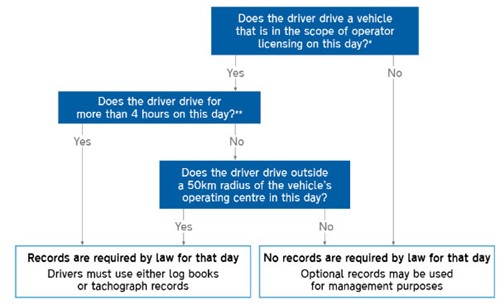
This exemption does not apply to drivers of Crown Vehicles that would have needed an ‘O’ licence if the vehicle had not been Crown Property. If this is the case, answer YES to the question in the flow-chart.
Any ‘Off-Road’ driving carried out for the purpose of Agriculture, Quarrying, Forestry, Building Work, Civil Engineering or Road Maintenance, does not count towards this total.
Emergencies
The GB domestic rules are relaxed in cases where immediate preventative action is needed to avoid:
- danger to the life or health of people or animals
- serious interruption of essential public services (gas, water, electricity or drainage), of telecommunication or postal services, or in the use of roads, railways, ports or airports
- serious damage to property
In these cases, the driving and duty limits are suspended for the duration of the emergency.
Records for vehicles carrying postal articles
Tachographs must be fitted and used on all vehicles with a permissible maximum weight in excess of 3.5 tonnes that carry parcels and letters on postal services. Drivers of such vehicles may be exempt from the EU rules on drivers’ hours (see EU rules exemptions) but if so, must still comply with the GB domestic rules.
Travelling Abroad
The GB domestic rules apply only in GB, but you must observe the national rules of the countries in which you travel. The embassies of these countries will be able to assist in establishing the rules that might apply.
For example, German national rules require drivers of goods vehicles between 2.8 and 3.5 tonnes to record details of their journeys in an AETR-style logbook. This means that GB drivers have to use the logbook when they set out and while driving through the countries on journeys to or through Germany. Copies of these logbooks can be obtained from the Road Haulage Association (Tel: 01733 263434).
Mixed Vehicle Types
If a driver divides their time driving goods vehicles and passenger vehicles under GB domestic rules, then in any working day or week, if they spend most of their time driving passenger vehicles then the appropriate GB rules for passenger vehicles apply for that day or week.
Working Time Regulations
Drivers who are subject to the GB domestic rules on drivers’ hours are affected by four provisions under GB Working Time Regulations 1998 (as amended) - See below for more details.
Driving under the GB domestic drivers’ hours rules (or are an occasional mobile worker)
If you drive a vehicle subject to the GB domestic drivers’ hours rules or are an occasional mobile worker (see text box below for definition), you are affected by four provisions under the 1998 Regulations.
These are:
- weekly working time, which must not exceed an average of 48 hours per week over the reference period, although individuals may ‘opt-out’ of this requirement if they wish.
- an entitlement to 5.6 weeks paid annual leave
- health checks for night workers
- an entitlement to adequate rest
Adequate Rest
Adequate rest means that workers should have regular rest periods. These rest periods should be sufficiently long and continuous to ensure that workers do not harm themselves, fellow workers or others and that they do not damage their health in the short or long term.
The reference period for calculating the 48-hour average week is normally a rolling 17-week period. However, this reference period can be extended up to 52 weeks, if this is permitted under a collective or workforce agreement.
The 1998 Regulations do not apply to self-employed drivers (see text box below for definition). Please note that this definition is different from the one used under the 2005 Regulations.
DVSA enforces the working time limits and the requirement for health checks for night workers under the 1998 Regulations for drivers operating under the GB domestic drivers’ hours’ rules (and occasional mobile workers). If you have any questions about matters relating to rest or annual leave, call the ACAS national helpline on 0300 123 1100, for free support and advice.
Further information
For further details on the 1998 Regulations, contact the Department for Business, Innovation and Skills on 020 7215 5000 or access their website at www.bis.gov.uk
Definition of a self-employed driver under the 2005 Regulations
‘Self-employed driver’ means anyone;
- whose main occupation is to transport passengers or goods by road for hire or reward within the meaning of Community legislation under cover of a Community licence or any other professional authorisation to carry out such transport
- who is entitled to work for himself and who is not tied to an employer by an employment contract or by any other type of working hierarchical relationship
- who is free to organise the relevant working activities,
- whose income depends directly on the profits made and
- who has the freedom, individually or through a co-operation between self-employed drivers, to have commercial relations with several customers (Regulation 2 of SI 2005/639).
Definition of an occasional mobile worker under the 2005 Regulations
A mobile worker would be exempt from the 2005 Regulations if:
- they work 10 days or less within the scope of the European drivers’ hours rules in a reference period that is shorter than 26 weeks or
- they work 15 days or less within the scope of the European drivers’ hours rules in a reference period that is 26 weeks or longer
Definition of self-employed under the 1998 Regulations
You are self-employed if you are running your own business and are free to work for different clients and customers.