Road Transport Operations Austria
Austria has a population of approximately 8.25 million. It shares borders with Switzerland, Liechtenstein, Germany, Czech Republic, Slovakia, Hungary, Slovenia and Italy. Austria has a very strong transport system of which it is rightly proud, with a road network comprising approximately 1,720 km of motorways and approximately 475 km of dual carriageways.
Rest / Parking Areas
Austria’s road infrastructure is managed by ASFINAG with the country’s top priority being to optimise road safety for all drivers. There are some 6,900 parking spaces in the ASFINAG network for the safety of lorry and bus drivers. As a result of this common-sense approach to road safety, all HGV drivers can easily comply with their legally prescribed breaks.
The rest area concept developed by ASFINAG delivers more safety and convenience with all new rest areas being well lit, fitted with video cameras and emergency phones, and modern sanitary arrangements and family-friendly facilities. The new rest areas are currently being fitted with defibrillators for first aid.
The communal areas are also fitted with drink vending machines and information boards about local sights. Some rest areas also have convenience kiosks (bakeries, coffee shop area) selling food and drinks.
Road Tolls
For vehicles with more than 3.5 tons maximum permissible weight (MPW) (which includes all lorries, buses and heavy camper vans), a mileage-based toll applies on Austria's motorways and expressways.
A driver must have a GO-Box (a fully electronic toll payment system) for any lorry over 3.5 tonnes maximum permissible weight (MPW) before driving onto a motorway or expressway. The toll can only be paid if you have a GO-Box, which is available from many GO-Box outlets. The rates depend, among other things, on the number of axles, the number of kilometres driven and the vehicle's EURO emission class. Payment may be made either in advance (pre-pay) or afterwards (post-pay), or it can for example be settled directly with ASFINAG via GO Direkt.
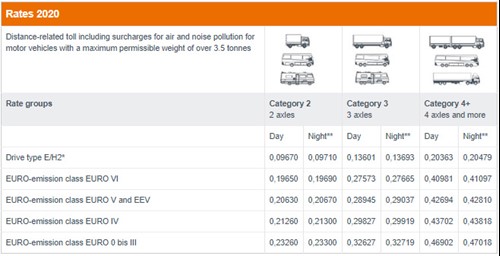 Rates are in Euros per km excluding 20% vat and are valid as of 1st January 2020.
Drive type E/H2 covers purely electric drives and hydrogen fuel cell drives. ** The night rates apply between 10 pm. and 5 am
Section Toll Segments
Increased rates still apply to the section toll segments:
- A9 Gleinalm or Bosruck Tunnel
- A10 Tauern Tunnel
- A11 Karawanken Tunnel
- A13 Brenner motorway
- S16 expressway Arlberg Tunnel
An increased rate (+25 % on the basic kilometre rate) is also applied for the A12 on the Lower Inn Valley route (between the border at Kufstein and the Innsbruck/Amras intersection).
EURO Emission Classes
The EURO emission class of the vehicle over 3.5 t MPW affects how much toll is due. The lower emissions, the cheaper the toll.
Cabotage
UK hauliers may carry goods to, through or from the country. Goods can also be carried from Austria to a third country and vice versa if permitted by the terms of any agreement between the three countries.
Cabotage is permitted, but a correctly completed control sheet must be carried on the vehicle. Control sheets are issued by Federal Ministry for Transport, Innovation and Technology, Radetzkystraße 2, A-1030 Vienna. A copy of the Austrian Cabotage control record is available to download below.
Dangerous Goods
The ADR agreement is in place and will apply. It should be noted that where vehicles are carrying dangerous goods and comply with all ADR requirements, there are specific additional requirements for the vehicle which may include additional lighting/beacons and/or escort vehicles where the vehicle movement has to travel via certain tunnels.
It should also be noted that there are further driving restrictions on vehicles carrying dangerous goods at certain times of the year and in general at certain times of the day in specific areas of Austria unless access for unloading is required.
For more information visit the UNECE website at the link below & select the country name applicable
http://www.unece.org/trans/danger/publi/adr/country-info_e.html
Abnormal Loads
On the ASFINAG network of roads, more than 10,000 special transports are carried out every year.
Special transports (in German, 'Sondertransporte', also called "Sotra") are transport units whose dimensions exceed the maximum permissible limits (for weight, width, length or height) defined in the Austrian Motor Vehicles Act (Kraftfahrgesetz 1967). All special transports require a special permit.
All abnormal load operators will require a keeper’s certificate to prove ownership of the trailer which must be carried as part of the vehicle documents at all times.
An application form can be downloaded below:
Where to get a permit for special transport
To carry out special transport in Austria, a request has to be submitted to the responsible provincial government. This has to be done via the Austrian e-Government-platform for special transports. In the course of the application, all the information necessary for the permit, such as planned route, detailed information on vehicle weight, axle loads, lorry bans on 3rd & 4th lanes of Motorways, distance between axles and vehicle dimensions, as well as the requested driving period, has to be stated.
The E-government-platform also contains useful information and links on the topic (for example a short summary of the Austrian Motor Vehicles Act, instructions for submitting a request and for using the platform, as well as information on the responsible authorities).
ASFINAG’s role in preparing a special transport permit
As the operator and maintainer of the high-profile road network in Austria, ASFINAG issues a statement to the responsible authorities for every special transport request affecting its road network. The statement is incorporated in the permit, which is issued by the responsible provincial government.
|
During the process of issuing statements, the special transport request is evaluated in technical and statistical terms and in terms of traffic management. By the specification of requirements and constraints, it is ensured that all safety and maintenance standards are met on the affected sections of the road network. There are certain periods in which it is not allowed to carry out special transports (for example during rush hours and peak traffic periods such as the start of the holidays or during major events). |
|
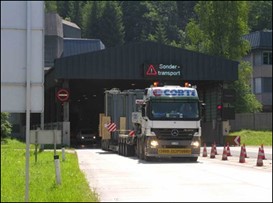
Additionally, special transports, depending on their dimensions, have to register with ASFINAG’s facilities in advance of the scheduled transport movement.
Registering special transports with ASFINAG
In general, special transports wider than 3.50 metres and/or higher than 4.30 metres are obligated to register with ASFINAG‘s regional traffic management centres and road maintenance departments (local registration). In addition, in certain cases, the central registration with the national traffic management centre is also obligatory (typically for special transports wider than 5.00 metres and/or heavier than 100 tonnes). If this is the case, it is also obligatory to communicate the actual departure time of the transport, longer breaks, as well as the arrival time of the transport.
All obligatory registrations for the particular transport (according to the individual permit) can be performed at once via ASFINAG‘s online-registration-platform (in German only). Excluded from the online-registration-platform are registrations for tunnel crossings with necessary closures of the tunnel, registrations with Bonaventura and the announcement of tunnel crossings by telephone (height control).
To register an Abnormal Load movement in Austria, please visit - https://sotra.asfinag.at/
Customs
TIR & ATA Carnets are accepted (conditions of use apply). CMR notes are required. All goods in free circulation do not require customs documents unless they are excise goods.
Lorry and Overtaking Bans
As in other European countries, certain restrictions are in place for use of the road network by heavy goods traffic. The lorry driving bans are in place to improve road safety, to improve traffic flow or to avoid the risks posed by lorries on the roads (such as lane changing). In addition to weekend and public holiday driving bans and the general night-time driving ban, the nine federal provinces have also issued their own specific lorry driving bans.
Lorry driving ban in 3rd and 4th lane of motorways/expressways
Since 1 June 2014, a driving ban for Lorries on the third and fourth lane of motorways and expressways has been in place in Austria. This ban is based on an expert report by the Austrian Road Safety Board from 2013. According to the report:
- on motorways, lorries are more often involved in accidents than cars
- lorries make up eleven per cent of the journeys on Austrian motorways and expressways.
- 22% of accidents involve personal injury, especially on three and four-lane motorways.
Weekend driving ban throughout Austria
This applies throughout Austria from Saturday, 3 pm to Sunday, 10 pm and on public holidays from midnight until 10 pm. It applies to:
- lorries with trailers, if the maximum permissible weight (MPW) of the lorry or the trailer is more than 3.5 tonnes.
- lorries, articulated lorries and self-propelled agricultural machines with an MPW of more than 7.5 tonnes
Certain food transports, if a consignment note or loading list can be produced, are exempt from this ban. The foods include fresh food such as fruit and vegetables, milk (products), meat (products), fish (products), eggs, mushrooms, baked foods and confectioneries.
General night-time driving bans
This applies on all Austrian roads for heavy goods vehicles with more than 7.5 tonnes MPW between 10 pm and 5 am.
Lorry overtaking bans
An overtaking ban may be imposed to prevent traffic congestion or accidents in bad weather. However, ASFINAG aims to adjust the time and location of the lorry overtaking bans to improve traffic flow. Seasonal lorry overtaking bans will be issued selectively in areas with sensitive winter road maintenance on steep stretches and in areas with increased risk of accidents.
Public Holidays
Please use the following link to view all public holidays in Austria. Also bear in mind that there are many local holidays in specific regions/cities https://www.feiertage-oesterreich.at/2020/
Driver Legal Documents
- A full passport is required but no visa is required
- The UK or International Driving Licence
- Letter from employer giving driver permission to drive vehicle (attestation letter and form).
If the UK fully leaves the EU on 31 January 2021, HGV drivers will require travel insurance with healthcare cover
Vehicle Legal Documentation
- A Green Card plus original vehicle registration docs.
- A GB plate must be fitted to the rear of the vehicle/trailer.
- A trailer registration certificate is a requirement. Registration for a certificate can be completed at: https://www.gov.uk/register-trailer-to-take-abroad
Safety Equipment
It is compulsory:
- to carry snow chains on vehicles over 3.5 tonnes between 15 November and 15 March
- that all vehicles over 3.5 tonnes are fitted with winter tyres between the same dates. Both chains and winter tyres have compliance requirements.
Other compulsory safety equipment requirements are:
- a warning triangle, which in the event of a breakdown, should be placed 50 metres behind the vehicle
- that seat belts must be worn at all times
- that reflective jackets must be worn (day or night) if the driver leaves the cab in the event of an accident or breakdown
- to have dipped headlights on at all times
- to carry a first aid kit
- two-wheel chocks if vehicle over 3.5 tonnes
- the minimum tyre tread depth is 2mm
Speed Limits
The following speed limits are applicable to all heavy goods vehicles over 3.5 tonnes GVW:
- URBAN ROADS – 50 kph
- NON-URBAN ROADS – 70 kph
- EXPRESSWAYS – 80 kph
- MOTORWAYS – 80 kph
Further Reading
The following links provides guidance and further information
British Embassy
Jauresgasse 12, 1030 Vienna
Tel: +43 (1) 716130
Web - https://www.gov.uk/world/organisations/british-embassy-vienna
Transport Organisation
Austrian International Road transport Operators association
Weidner Haupstrasse 68
5th Floor
A-1040 Vienna
Tel – (01) 961 63 63
Email - office@aisoe.at
Web - www.aisoe.at