Road Transport Operations France
Is the largest country in the EU, with its capital Paris having a population of 12 million people. France has borders with 8 other countries and is therefore the route across to many European countries from the UK via the channel which is the busiest seaway in the world.
The main ferry route to France is Dover to Calais, but Dover to Dunkerque, Newhaven to Dieppe, Portsmouth to Le Havre and Portsmouth to Caen/St. Malo, Poole and Cherbourg, and Plymouth to Roscoff are all alternatives. Eurotunnel offers even faster access from Folkestone to Calais.
Documents and other requirements for lorry drivers
All commercial drivers should carry a full passport and their driver's licence, as well as a letter of authority from their operator that they have the authority to drive the vehicle, which explains the relationship between them and the vehicle owners, as well as the reason for travel. It also needs to state the member state of residence of the driver.
Certificate for International Transport Workers
Previously all those driving to France, including freight operators, had to complete an International Attestation to confirm that their journey met the criteria for essential travel. This was designed to curb non-essential travel.
More recently French authorities have confirmed that, for drivers of vehicles performing international transport of goods by road, a completed Certificate for International Transport Workers will be accepted and they no longer need the International Attestation.
To download the form:
EU driver's regulations apply fully in France, and the driver should also carry a letter from his company in the correct language for any countries he is passing through, with details of where past tachograph records can be found.
Drivers who are on prescribed medication must carry a copy of their prescription or details of the medicines.
Using mobile phones unless they are hands-free is illegal, and snow chains are compulsory anywhere where there are road signs indicating they must be used – ‘Equipments Speciaux Obligatories’.
There is also a legal requirement for drivers to carry:
- reflective jackets for all occupants of the vehicle
- a warning triangle
- spare bulb kit
- breathalyser test kit (preferably 2)
Cabotage
UK hauliers may carry goods to, through or from the country. Goods can also be carried from France to a third country and vice versa if permitted by the terms of any agreement between the three countries. Cabotage is permitted.
Dangerous Goods
France is a party to ADR, however, there are restrictions on the movement of Dangerous Goods on bridges and in tunnels.
Restrictions are applied in the following areas and fines for any contravention are heavy:
- Region of Haute Savoie
- Coastal Roads of Lake Geneva (Lac Leman)
- All Alpine Tunnels
- Saturday and days preceding a Public Holiday
For further information, visit the UNECE website at the link below & select the country name applicable https://unece.org/transport/documents/2021/03/standards/adr-competent-authority-and-notifications-france
Abnormal Loads
Special authorisations are required for all abnormal load movements which exceed French vehicle dimensions (including weight). Applications for authorisations must be made to the 'Directorate of Equipment' of the prefecture of entry into France and every prefecture where the load is to move through en route to its destination.
Abnormal loads cannot move if the weather conditions include snow, ice and fog or when visibility is below 150 metres.
All abnormal load operators will require a keeper’s certificate to prove ownership of the trailer which must be carried as part of the vehicle documents at all times.
An application form can be downloaded below:
Customs
TIR carnets are accepted for vehicles crossing France. ATA Carnets are accepted for certain temporary imports. CMR documents should be used at all times.
Movement Restrictions (HGV road bans)
Most heavy goods vehicles over 7.5 tonnes are banned from the French road and motorway network every weekend. There are exceptions for trucks carrying (ambient) perishable produce or refrigerated produce, trucks servicing sporting events or trade fairs, and also fuel, air cargo and essential product movements.
Restrictions apply as follows:
- Saturday 22:00 until Sunday 22:00
- The day before public holidays from 22:00
- Public Holidays to 22:00
Additional summer weekend HGV bans
The weekend truck ban is longer from early July to mid-August when HGVs are banned from:
- Saturday 07:00 to 19:00
- Saturday 22:00 to Sunday 22:00
HGV's are also banned on public holidays from 22:00 the night before, until 22:00 on the holiday itself. The two big summer public holidays in France are the 14th of July and the 15th of August. When these public holidays fall on a Saturday or Sunday, lorries are banned for the complete 24-hour period.
Bank Holidays
- 1 Jan – New Year’s Day
- 10 April – Good Friday
- 13 April – Easter Monday
- 1 May – Labour Day
- 8 May – Victory Day
- 21 May Ascension day
- 31 May – Whit Sunday
- 1 June – Whit Monday
- 14 July – Bastille Day
- 15 August Assumption Day
- 1 Nov – All Saints Day
- 11 Nov - Armistice Day
- 25 Dec – Christmas Day
- 26 Dec – St Stephens Day (Boxing Day)
Paris area HGV restrictions
There are restrictions in force for HGVs in the Paris area as follows:
- HGVs cannot enter the Paris area on Mondays and the day following a public holiday. Restrictions are from 06:00 to 10:00.
- HGVs cannot leave the Paris area on Fridays and the days preceding a public holiday, from 16:00 onwards.
This, therefore, means that lorries cannot transit via the inner ring road of Paris (boulevard périphérique) during these hours.
HGV restrictions on Alpine Motorways
There are also extra weekend lorry bans on alpine motorways in February, though given the traffic jams that are possible here, these routes are best avoided by anyone not needing to use them.
Weather Conditions
It is advisable to check weather forecasts for France, especially in winter. With the general exception of western routes via Tours and Bordeaux, routes crossing France towards Germany, Switzerland, Italy, Spain and Portugal may be subject to heavy snow, notably in mountain areas (Alps, Vosges, Massif Central).
Trunk roads not accessible to HGVs
There are a small number of trunk routes in France from which HGVs over 7.5 tonnes or over 19 tonnes are permanently banned.
The most important of these are:
- The underground section of the A86 Paris orbital motorway, around the northwest of Paris (not just banned, but impossible due to height restriction)
- The A6 - A7 motorway route through the centre of Lyon (use the Lyon orbital routes)
- The N59 from Lunéville (Lorraine) to Sélestat (Alsace)
- The N66 from Remiremont (Lorraine) to Cernay (Alsace)
- The N73 from Chalon sur Saône (Burgundy) to Dole (Franche-Comté)
- The N20 between Linas and Massy on the western exit from Paris
- The D2020 (ex N20) south of Orleans to La Ferté St Aubin
- Motorways through the centre of Lyon (it’s better to take the orbital routes)
In other places, HGVs may be banned from short sections of routes and are obliged to use a nearby alternative.
Road Tolls
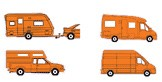
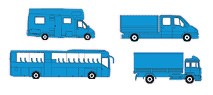
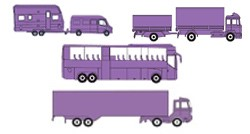
Road tolls are governed by the vehicle category which is determined by three criteria:
- Overall height
- Gross vehicle weight (GVW)* (for trains, the towing vehicle only)
- The number of axles.
One of the most comprehensive and best resources for checking tolls, bridge and tunnel charges is https://www.tolls.eu/ This online publication also gives similar information for a total of 25 European Countries (including the UK).
For buses, trucks, road trains or large caravans with two axles or more and with specific heights, the following applies:
|
Category |
Vehicle Types |
Definition |
|
2 |
Intermediate vehicles |
A vehicle with an overall height from 2 to 3 metres and GVW not exceeding 3.5 tonnes
Train with an overall height from 2 to 3 metres and GVW of towing a vehicle not exceeding 3.5 tonnes |
|
3 |
HGV or bus with two axles On the A14, all two-axle buses are in category 4
|
A vehicle with an overall height of 3 metres or more
A vehicle with a GVW of more than 3.5 tonnes |
|
4 |
HGV or bus with three or more axles
|
A vehicle with more than two axles and a height of 3 metres or more, or GVW of more than 3.5 tonnes
Train with an overall height of 3 metres or more
Train with a towing vehicle having a GVW of more than 3.5 tonnes |
For more information on Motorway tolls in France - https://www.autoroutes.fr/index.htm
Toll Bridges and Tunnels
There are several road tunnels and bridges in France. The most formidable barrier to negotiate, however, is the Alps, which are home to two of the most famous tunnels in Europe, the Frejus and Mont Blanc Tunnels.
Please use the links to the right of each tunnel or bridge in the table below which will take you to the relevant website and in most cases the tariff charge page for road tolls or bridge/tunnel charges. Please also remember that charges vary for the time of year you use the facility.
|
Place/category |
I |
II |
III |
IV |
V |
link |
|
Tunnel du Puymorens |
€6,70 |
€13,70 |
€22,40 |
€36,80 |
€4,00 |
|
|
Tunnel Maurice-Lemaire |
€6,00 |
€9,40 |
€16,70 |
€28,00 |
€3,60 |
|
|
Pont de Normandie |
€5,50 |
€6,40 |
€7.00 |
€13,80 |
free |
|
|
Pont de Trancarville |
€2,60 |
€3,30 |
€3,90 |
€6,70 |
free |
|
|
Viaduc de Millau |
€11.00 |
€16.50 |
€30.00 |
€38.00 |
€5.40 |
|
|
Tunnel du Fréjus |
€45,20 |
€59,80 |
EURO cat. |
EURO cat. |
€29,90 |
|
|
Tunnel du Mont Blanc |
€43,50 |
€57,60 |
EURO cat. |
EURO cat. |
€28,80 |
|
|
Tunnel Prado Carénage |
€2.80 toll for vehicles up to 3.5 tons and a height up to 3.2 m |
|||||
|
Tunnel Duplex |
Fee €9, 30 - €2, 6 (depending on day and time of passage) for vehicles with a height of up to 2m. No entry for motorcycles and vehicles on LPG. |
|||||
Tunnel Information
- Frejus (A43) - Connects to A32 M/Way in Italy
- Mont Blanc (A40) - Connects Haute Savoie region (F) to Aosta Valley (I)
- Maurice Lemaire (N59 Lorraine Region) - Connects Sainte-Marie-aux-Mines and Saint-Dié
- Puymorens (N20 Pyrénées Region) - Connects Worn-Puymorens (Pyrénées-Orientales) and L'Hospitalet-près-l'Andorre (Ariège)
Bridge Information
- Pont de Normandie (A29) - Normandie at the Seine river delta, eastern part of Le Havre, near Honfleur
- Pont de Tancarville (A15) - Tancarville at the Seine river delta
Vehicle Legal Documentation
- Green Card required, plus original vehicle registration docs.
- A GB plate must be fitted to the rear of the vehicle/trailer.
- A trailer Registration Certificate is a requirement.. To register for a trailer certificate visit https://www.gov.uk/register-trailer-to-take-abroad
Safety Equipment
In the best interest of road safety, the following compulsory safety equipment or requirements and advice should be adhered to:
- A warning triangle
- Seat belts must be worn at all times
- Reflective jackets must be worn (day or night) if the driver leaves the cab in the event of an accident or breakdown
- Dipped headlights in adverse weather conditions or restricted visibility
- First Aid Kit
- Fire Extinguisher
- The use of snow chains is advisable in snow/icy conditions
Driver Legal Documents
- Full passport required but no visa required.
- Full UK driving Licence.
- Letter from employer giving driver permission to drive vehicle (attestation letter and form)..
If the UK fully leaves the EU on 31 January 2021, HGV drivers will require travel insurance with healthcare cover
Speed Limits
|
Vehicles Concerned |
Built-Up Areas (kms) |
Outside Built-Up Areas (kms) |
Expressways / Dual |
Motorways (kms) Max 80 kms in left lane |
|
All Trucks 3.5 tonnes to 12 tonnes |
50 |
80 |
90 |
90 |
|
Rigid Truck over 12 tonnes |
50 |
80 |
80 |
90 |
|
Artic/Road Train over 12 tonnes |
50 |
60 |
80 |
90 |
|
Dangerous Goods Transport 3.5 tonnes to 12 tonnes |
50 |
80 |
90 |
90 |
|
Dangerous Goods Transport over 12 tonnes |
50 |
60 |
70 (Only if ABS fitted) |
80 |
|
Indivisible Loads (Cat 1) |
50 |
60 |
60 |
80 |
|
Indivisible Loads (Cat 2) |
40 |
60 |
60 |
80 |
|
Indivisible Loads (Cat 3) |
30 |
50 |
50 |
60 |
Maximum Weights & Dimensions
The following are applicable:
Height - There is no fixed height. However, we suggest that operators conform to 4 metres, or plan their vehicle's routes accordingly.
Width - 2.55 metres (Fridges 2.6 metres).
Length - Artic 16.5 metres, Road Train 18.75 metres. There are also other maximum lengths on vehicles and trailers according to the number of axles.
Weight - Artic 40 tonnes (ISO containers (40ft) - 44 tonnes). Road Trains are 44 tonnes. There is also various maximum permitted weights on vehicles, trailers and road trains which are applicable according to the number of axles.
The following links provide guidance and further information
British Embassy
35, rue du Faubourg St Honore
Paris Cedex 08 Paris
75383 Paris
Tel: +33 (1) 44 51 31 00
Web: https://www.gov.uk/world/organisations/british-embassy-paris
Transport Organisations
Association Francais du Routier International (AFTRI)
48 rue de la Bienfaisance
75008 Paris Tel: +33 (1) 53 53 02 40
Web: http://www.aftri.com/
National Federation of Road Transport - http://www.fntr.fr/
Traffic/Road Conditions in France - https://www.bison-fute.gouv.fr/